
This past week, the Arizona Republic published a six-part series on sustainability, and in Sunday’s editorial, the Republic opined that “…Arizona still seems in the minor leagues. The efforts need to be bigger, better, faster.” So how does Arizona fare? SustainLane, cited in the Republic’s series, ranked America’s cities in 15 categories using data culled from a variety of sources, including city governments. Of the top 50 cities in the U.S., Tucson ranked #20, Phoenix #22, and Mesa #47. Here’s the 2006 scoring and commentary for Phoenix:
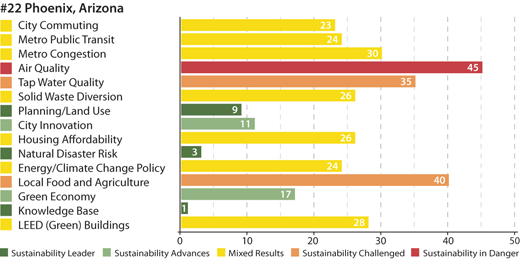
Phoenix has a reputation as a retirement community with a relaxing desert environment, abundant sunshine, and lots of golf courses — and until recently, it was pretty much just that. In 1950, there were only 105,000 people living within the city limits and less than half the streets were paved. Now, Phoenix is the fifth-largest city in the United States.
Because Phoenix is such a new city and grew so fast, it is markedly different from other large US cities. Phoenicians resisted growth by trying to preserve a small-town feel (it wasn’t until the 1980s that the city surrendered to a highway system). Its residents are passionate about preserving wide-open landscape views, so growth has been channeled into low-density sprawl.
Climate is one of Phoenix’s defining features. In the Navajo language, Phoenix is called Hoozdo, or “the place is hot.” The summer temperature exceeds 100 degrees an average of 89 days of the year, with a record high of 122 degrees in 1990. Phoenix lies in a valley in the heart of the Sonoran Desert. Winters are mild and sunny with huge temperature fluctuations. Daytime temperatures might reach 70 degrees while nighttime temperatures can plummet to 30 degrees.
Due to its rapid growth, Phoenix is an adolescent compared to most other large US cities. As a result, the city faces challenges that many other large cities addressed long ago, though residents and government alike are beginning to address these issues. The introduction of light rail, expansion of urban parks, and interest in LEED certified buildings are a good start. Another opportunity the city might consider would be to create incentives for urban infill projects and planning for public transit and pedestrian-friendly environments. The U.S. Green Building Council’s LEED for Neighborhood Developments, or LEED-ND, would be a great model for the city to use as a guideline.
[Note: To review and download the Downtown Voices Coalition 2004 report, “Downtown Voices: Creating a Sustainable Downtown,” click here.]
 Downtown Voices Coalition